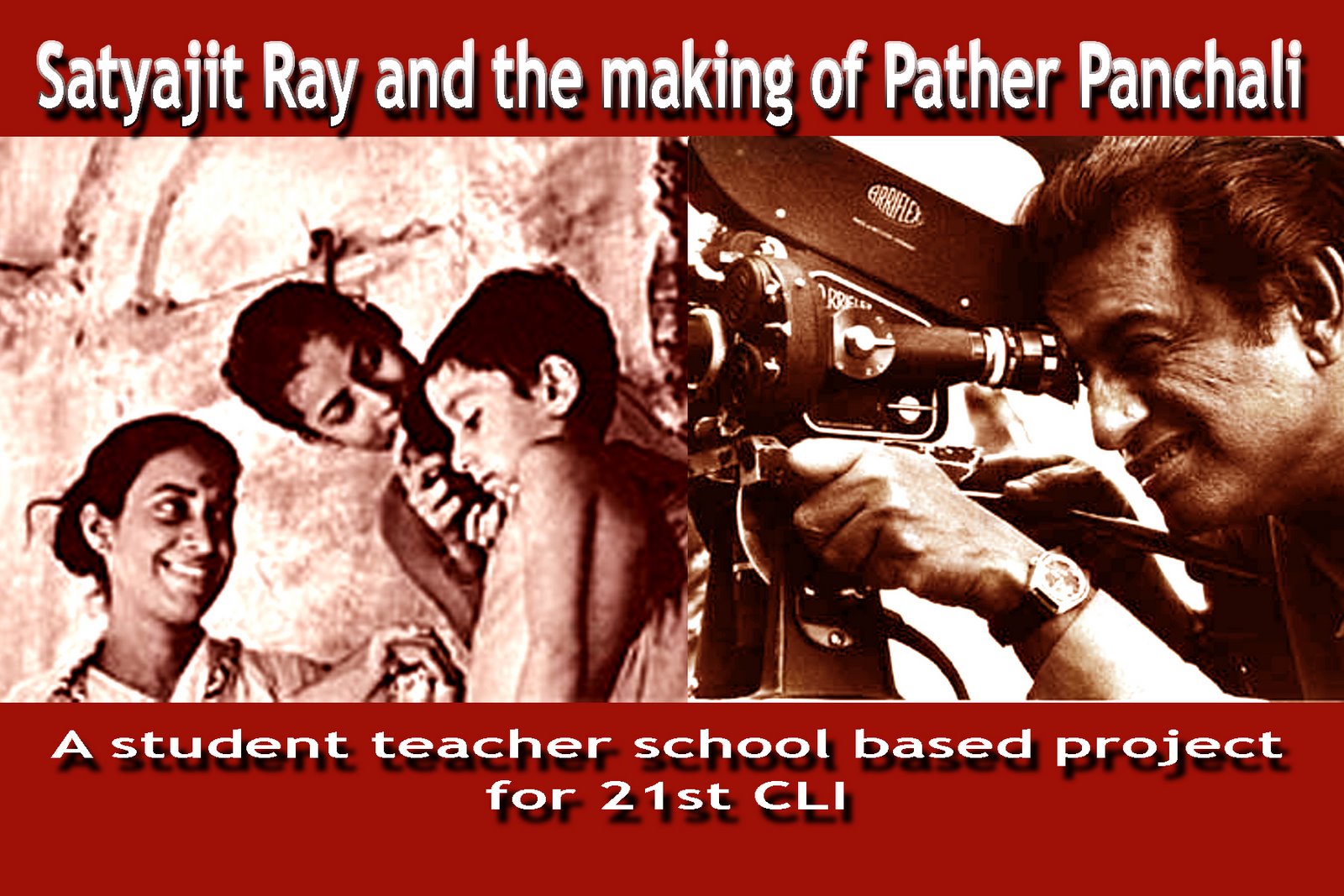
Satyajit Ray (Bengali:
সত্যজিত রায় or
সত্যজিৎ রায় Shottojit Rae (help·info)) (2 May 1921–23 April 1992) was a Bengali Indian filmmaker. He is regarded as one of the greatest auteurs of 20th century cinema. Born in the city of Kolkata (then known as Calcutta) into a Bengali family prominent in the world of arts and letters, Ray studied at Presidency College and at the Visva-Bharati University. Starting his career as a commercial artist, Ray was drawn into filmmaking after meeting French filmmaker Jean Renoir and viewing the Italian neorealist film Bicycle Thieves during a visit to London.
Ray directed thirty-seven films, including feature films, documentaries and shorts. Ray's first film, Pather Panchali, won eleven international prizes, including Best Human Document at Cannes film festival. Along with Aparajito and Apur Sansar, the film forms the Apu trilogy. Ray did scripting, casting, scoring, cinematography, art direction, editing and designed his own credit titles and publicity material. He was a fiction writer, publisher, illustrator, graphic designer and film critic. Ray received many major awards, including an Academy Honorary Award in 1992.
Early Life.... Satyajit Ray's ancestry can be traced back at least ten generations. Ray's grandfather, Upendrakishore Raychowdhury was a writer, illustrator, philosopher, publisher, an amateur astronomer, and a leader of the Brahmo Samaj, a religious and social movement in nineteenth century Bengal. Sukumar Ray, Upendrakishore's son, was a pioneering Bengali writer of nonsense rhyme and children's literature, an illustrator and a critic. Ray was born to Sukumar and Suprabha Ray in Kolkata. Sukumar Ray died when Satyajit was barely three, and the family survived on Suprabha Ray's meager income. Ray studied economics at Presidency College in Kolkata, though his interest was always in fine arts. In 1940, his mother insisted that he study at the Visva-Bharati University at Santiniketan, founded by Rabindranath Tagore. Ray was reluctant due to his love of Kolkata, and general low impression about the intellectual life at Santiniketan.[2] His mother's persuasion and his respect for Tagore finally convinced him to try this route. In Santiniketan, Ray came to appreciate oriental art. He later admitted that he learnt much from the famous painters Nandalal Bose[3] and Benode Behari Mukherjee on whom Ray later produced a documentary film, "The Inner Eye". With visits to Ajanta, Ellora and Elephanta, Ray developed an admiration for Indian art.
Ray left Santiniketan in 1943 before completing the five-year course and returned to Kolkata, where he took a job with a British advertising agency, D.J. Keymer. He joined as a "junior visualiser", earning just eighty rupees a month. Although on one hand, visual design was something close to Ray's heart and, for the most part, he was treated well, there was palpable tension between the British and Indian employees of the firm (the former were much better paid), and Ray felt that "the clients were generally stupid".[5] Around 1943, Ray became involved with Signet Press, a new publishing house started up by D. K. Gupta. Gupta asked Ray to create.
Literary Works....... Ray created two very popular characters in Bengali children's literature—Feluda, a sleuth, and Professor Shonku, a scientist. He also wrote short stories which were published as volumes of 12 stories, always with names playing on the word twelve (for example Eker pitthe dui, or literally "Two on top of one"). Ray's interest in puzzles and puns is reflected in his stories, Feluda often has to solve a puzzle to get to the bottom of a case. The Feluda stories are narrated by Topshe, his cousin, something of a Watson to Feluda's Holmes. The science fictions of Shonku are presented as a diary discovered after the scientist himself had mysteriously disappeared. Ray's short stories give full reign to his interest in the macabre, in suspense and other aspects that he avoided in film, making for an interesting psychological study.[47] Most of his writings have now been translated into English, and are finding a new group of readers.
Most of his screenplays have also been published in Bengali in the literary journal Eksan. Ray wrote his autobiography encompassing his childhood years, Jakhan Choto Chilam (1982) and essays on film: Our Films, Their Films (1976), along with Bishoy Chalachchitra (1976), Ekei Bole Shooting (1979). During the mid-1990s, Ray's film essays and an anthology of short stories were also published in the West. Our Films, Their Films is an anthology of film criticism by Ray. The book contains articles and personal journal excerpts. The book is presented in two sections—Ray first discusses Indian film, before turning his attention towards Hollywood and specific international filmmakers (Charlie Chaplin, Akira Kurosawa) and movements like Italian neorealism. His book Bishoy Chalachchitra was translated in 2006 as Speaking of Films, and contains a compact description of his philosophy of different aspects of the cinema. Ray also wrote a collection of nonsense verse named Today Bandha Ghorar Dim, which includes a translation of Lewis Carroll's "Jabberwocky"
Film Craft..... Satyajit Ray considered script-writing to be an integral part of direction. This is one reason why he initially refused to make a film in any language other than Bengali. In his two non-Bengali feature films, he wrote the script in English, which translators then interpreted in Hindi or Urdu under Ray's supervision. Ray's own eye for detail was matched by that of his art director Bansi Chandragupta, whose influence on the early Ray films were so important that Ray would always write scripts in English before creating a Bengali version, so that the non-Bengali Chandragupta would be able to read it. Camera work in Ray's early films garnered high regard for the craft of Subrata Mitra, whose (bitter) departure from Ray's crew, according to a number of critics, lowered the quality of cinematography in his films.[41] Though Ray openly praised Mitra, his single-mindedness made him take over operation of the camera since Charulata, causing Mitra to stop working for Ray after 1966. Pioneering works of Subrata Mitra included development of "bounce lighting", a technique of bouncing light off cloth to create a diffused realistic light even on a set. Ray also acknowledged debt to Jean-Luc Godard and François Truffaut of the French New Wave for introducing new technical and cinematic innovations.[42]
Though Ray had a regular editor in Dulal Datta, he usually dictated the editing while Datta did the actual work. In fact, because of financial reasons and Ray's meticulous planning, his films were mostly cut "on the camera" (apart from Pather Panchali). At the beginning of his career, Ray worked with Indian classical musicians, including Ravi Shankar, Vilayat Khan and Ali Akbar Khan. However, the experience was painful for him as he found that their first loyalty was to musical traditions, and not to his film; also, his greater grasp of western classical forms, which he regarded as essential, especially for his films set in an urban milieu, stood in the way.
Contributed by: SASRABASTI P
References: Web content materials.